
As we approach the end of 2025 and matric exams conclude, South Africa faces a deepening crisis in access to higher education. Youth unemployment remains alarmingly high—recent figures from Statistics South Africa estimate that over 59% of people aged 15–24 are unemployed. In this context, a university degree is increasingly seen as essential for improving job prospects. This year, a record 900,000 candidates are writing matric. Yet, of the 430,000 expected to qualify for university entrance, only about half (235,000) will be admitted to one of the 26 universities. The competition is at an all-time high, and the stakes for young people are critical.
Compounding these challenges, universities are contending with shrinking budgets. The Auditor-General’s 2023 report reveals that funding for higher education has declined in real terms for nearly five consecutive years, with funding increases not keeping pace with inflation. This has resulted in reduced per-student expenditure, even as enrolments rise. Consequently, infrastructure, staff, and academic quality are under mounting pressure, threatening the sustainability of the entire sector. Students who do gain admission often face delayed NSFAS (National Student Financial Aid Scheme) disbursements, inadequate accommodation, overcrowded lecture halls, and overburdened lecturers, all of which collectively undermine the quality of teaching and learning.
South African youth face a dual dilemma: limited access to university amid a climate of “qualifications inflation,” where even menial jobs require degrees, all while unemployment soars and the higher education system is stretched by budget cuts and increasing enrolments.
It is important to recognise that, nearly fifty years after the Soweto Uprising of 1976, South African youth are once again at a crossroads. In 1976, students mobilised against Bantu Education and the enforcement of Afrikaans as a medium of instruction—a system designed to entrench racial and class subjugation. Today, although the context has changed, the crisis in education remains, now worsened by neoliberalism, state neglect, and the commodification of learning.
Neoliberalism refers to economic policies that emphasise privatisation, deregulation, and reduced government spending, often resulting in increased inequality and weakened public services. In the education sector, this shift has moved responsibility away from the state, treating learning as a commodity to be bought and sold. Despite the official end of apartheid and the promise of transformation, youth continue to confront the reality of broken schools and burning campuses. It is time to rebuild a unified, principled student movement rooted in working-class struggles, honouring the legacy of 1976 by fighting for quality education.
The demand for increased university intake collides with persistent budget constraints. The Auditor-General’s 2023 report documents a consistent decline in real funding per student since 2021, even as enrolment surges. This has led to deteriorating infrastructure, shortages of student accommodation, and overcrowded lecture halls. Many students endure long delays in financial aid disbursements (NSFAS), further compounding their difficulties.
Academic staff are also stretched thin, with heavier workloads and limited resources undermining their capacity to deliver quality education. The pressure on both physical and human resources is eroding the foundations of higher education and compromising its long-term sustainability. With university budgets shrinking and enrolments growing, campuses are becoming increasingly overcrowded, and resources are becoming scarcer, leading to declining educational quality.
The historic struggle for educational dignity and relevance continues, now shaped by new economic and political forces that necessitate renewed activism. You can access the Draft Programme and Platform for Youth and Students to help build a new socialist youth and student movement here
Neoliberal Policy and Corporate Tax Reduction
To understand the genesis of these challenges, one must examine the impact of neoliberal economic policies on South African universities. Neoliberalism, as previously defined, promotes privatisation, reduced public spending, and reliance on free-market solutions. This policy trajectory was adopted globally by the capitalist class as the post-World War II economic boom ended in the late 1960s and early 1970s. Previously, high levels of taxation on corporates had financed significant social reforms, including free education, healthcare, social security, and housing.
As profits declined, capitalists pressured governments to reduce corporate taxes and open public services such as water, education, health, and electricity to private profit. In South Africa, the apartheid regime nationalised services and maintained higher corporate taxes to finance white-only reforms. By the mid-1980s, however, the capitalist class began pressuring the regime to reduce taxes and privatise services. The ANC government, under further pressure after 1994, continued this trend, imposing the neoliberal Growth, Employment and Redistribution strategy in 1996. Corporate tax rates fell from 52% in 1992 to 27% today, but promised investment did not materialise. Gross fixed capital formation remains at 1946 levels, while manufacturing capacity utilisation dropped to around 65% as of May 2025. Meanwhile, the top 10% now own 84% of wealth in income and assets, poverty has deepened, and unemployment remains severe.
Instead of increasing social spending to match the demographic realities of a majority Black population, the government reduced corporate tax, cut spending, and resorted to borrowing. Today, R1.1 billion is spent daily on debt servicing—22 cents of every Rand in the annual budget. This has led to limits and cuts in social spending, forming the root of the education crisis, alongside crises in housing, health, and social services.
Commodification and Privatisation in Higher Education
Education suffered as colleges closed, university subsidies were reduced, and costs increased through measures like the merging of historically white and Black institutions. This process commodified education—transforming it from a public good aimed at social upliftment into a market-driven product for individual advancement and profit. Commodification manifests as rising tuition, cost-sharing models, and increased reliance on private funding. Universities operate more like businesses, prioritising branding, performance metrics, and efficiency at the expense of critical pedagogy and transformation.
As public funding declined, universities turned to private partnerships and donor funding, increasing inequality and financial exclusion—especially for working-class and Black students. Privatisation created opportunities for profiteering and corruption. The consequences are stark: rising school dropout rates, increasing numbers of NEETs (not in employment, education, or training), and growing student debt. Academic staff face pressure to publish and fundraise, with research often shaped by corporate interests. Technology is used as a substitute for in-person teaching, widening the digital divide. Despite rhetoric about transformation, real structural change is hampered by a narrow focus on diversity statistics and return on investment.
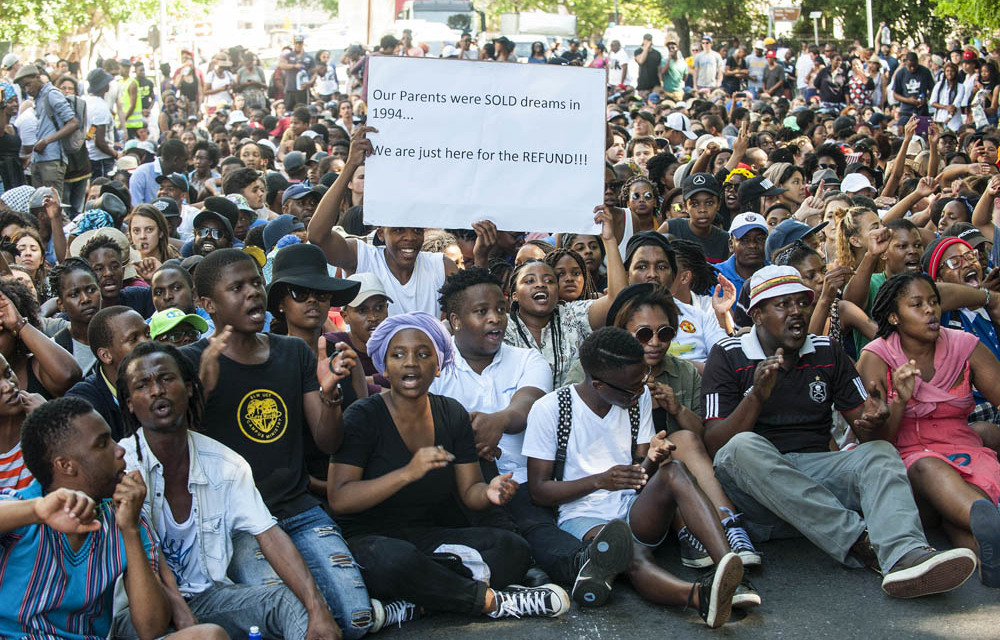
Movements like #FeesMustFall and #RhodesMustFall emerged in response, demanding free, decolonised education and challenging neoliberal university practices. Although some progress was made—such as securing free education for some—investment in staffing, infrastructure, and expansion of institutions did not follow. As a result, higher education stands at a tipping point.
The Fort Hare Arson Attack: A Symbol of Crisis
The October 2025 arson attack at the University of Fort Hare, which destroyed infrastructure worth over R500 million, starkly illustrates the crisis facing higher education. Once a beacon in the struggle for African liberation, Fort Hare now symbolises decline, a result of sustained neglect and mismanagement. Efforts to address these problems have met resistance: Vice-Chancellor Sakhela Buhlungu’s anti-corruption campaigns have reportedly made him a target, highlighting the risks faced by reformers in compromised institutions.
Many student grievances—such as unsafe housing, delayed SRC elections, and exclusionary decision-making—are legitimate. However, these issues have sometimes been manipulated by corrupt networks, including those with political connections, seeking to destabilise universities for personal gain. Since 2010, at least 10 higher education institutions, mostly historically disadvantaged or merged universities, have been placed under administration due to governance failures or financial mismanagement. The Auditor-General’s 2023 report points to ongoing risks, including irregular procurement and weak financial controls. Chronic dysfunction, as described by Jonathan Jansen in his study of South African universities, stems from a lack of institutional capacity and integrity. However, these issues are not merely the result of a crisis of values or a simple lack of institutional capacity. Rather, they are the inevitable outcomes of neoliberal economic policies that prioritise the privatisation and commodification of goods and services once managed by the state for public benefit. The transformation of public assets into private commodities has undermined the foundational purpose of higher education, replacing collective advancement with individual gain and exacerbating systemic inequalities.
The destruction at Fort Hare is not only physical but ideological. When legitimate student grievances are co-opted by corrupt actors, student power is weakened, and criminal syndicates exploit education for profit. The absence of independent, democratic, and principled student organisations leaves students vulnerable to manipulation and unable to effectively challenge systemic injustice.
Schooling Crisis: Persistent Inequality and Structural Violence
Since 2021, declining funding for public schools has led to soaring learner-teacher ratios—sometimes as high as 100 to one—and inadequate classroom resources. The Department of Basic Education reports that fewer schools are able to offer essential subjects like mathematics and science, further limiting opportunities for higher education.
Quintile 5 (Model C) schools, introduced under the neo-liberal GEAR policy, were intended to offer parents and communities a greater say in school governance. In practice, this shifted the financial burden of education from the state to wealthier parents, excluding the poor majority. Today, even these schools face subsidy cuts, threatening infrastructure and increasing class sizes. Township and rural schools remain overcrowded, under-resourced, and often unsafe. Learners are alienated by the curriculum, face language barriers, and endure authoritarian discipline. Black working-class youth are especially affected, attending schools plagued by drug abuse, gender-based violence, and bullying. Despite the end of apartheid, the legacy of Bantu Education persists, preparing youth for low-wage work or unemployment rather than empowerment and advancement.
Towards a New Youth and Student Movement
Addressing these entrenched challenges requires an approach grounded in an understanding of the root causes—neoliberal capitalism—and their interconnection with the broader socio-economic crises. Drawing on both the successes and limitations of movements like #FeesMustFall, the MWP proposes a new, independent, democratic, and socialist youth and student movement. This movement must reach beyond universities to include TVET and community colleges and high schools, uniting all educational sectors.
Existing structures for learner and student participation are often weak, captured, or dysfunctional. University SRCs and Representative Councils for Learners need revival, strengthening, and reclamation. Several concrete reforms can help achieve this:
- Transparent election processes: Open, fair, and interference-free elections can restore trust. For example, some universities have implemented online voting and independent monitoring committees, boosting turnout and reducing fraud allegations.
- Regular training for members: Ongoing leadership and ethics training equips council members to serve effectively. Partnerships with NGOs or educational foundations have improved council performance and responsiveness.
- Oversight committees: Independent bodies to audit council activities and finances can prevent capture and corruption. Peer review panels and public reporting have produced greater transparency and accountability.
- Uniting education structures: SRCs and RCLs can coordinate regionally and provincially, supporting campaigns and including unemployed youth in community advocacy for NEETs.
Dysfunctional councils pose real risks. Misappropriated funds and unaddressed grievances have led to distrust and disengagement. For instance, a 2023 survey found over 60% of university students felt unrepresented by their SRC, citing lack of transparency and nepotism. This highlights the urgency of reform and the transformative potential of strong participation structures. By implementing these measures, councils can genuinely advocate for students, resist corruption, and drive positive change in education and society.
Where councils have been co-opted, a renewed campaign must connect specific issues in education to their economic causes and advance a fighting programme based on:
- Socialist principles: Education is a right, not a commodity
- Abolition of student debt
- Free education from pre-school to tertiary level
- Ending outsourcing and private funding, and eliminating corporate branding in faculties
- Permanently employing all education workers on a minimum wage of R12,500 per month with full benefits
- Taxing the rich
- Jobs for all—utilising idle manufacturing capacity
- Democratic accountability: Student leaders should answer to students, not funders or political factions
- Class struggle: Linking campus demands with broader worker and community movements for social justice
- Abolishing capitalism: Nationalising key sectors under worker control for socialist transformation
- Internationalism: Building solidarity with youth and students across Africa and globally against neo-colonialism, neo-liberalism, and capitalism
The goal is not symbolic protest, but real power—from lecture halls to picket lines. A new, unified youth and student movement must be independent, democratic, and rooted in socialist principles, reaching across all levels of education.
South Africa’s education crisis is shaped by shrinking budgets, neoliberal policies, corruption, and entrenched inequality. Burning campuses and broken schools are not inevitable—they result from policy choices and systemic neglect. By grasping the historical, economic, and ideological roots of the crisis, students and youth can build a powerful, unified movement for change. The approaching 50th anniversary of the Soweto Uprising should be marked not only with remembrance, but with renewed commitment to the struggle for quality education, equality, and socialism. The time to act is now.
Please click the link below to complete the form if you would like to help start a branch of the Marxist Youth and Student Movement at your learning institution. Let us target 16 June 2025 to commemorate the 50th anniversary of the Youth Uprising with a new youth and student movement.