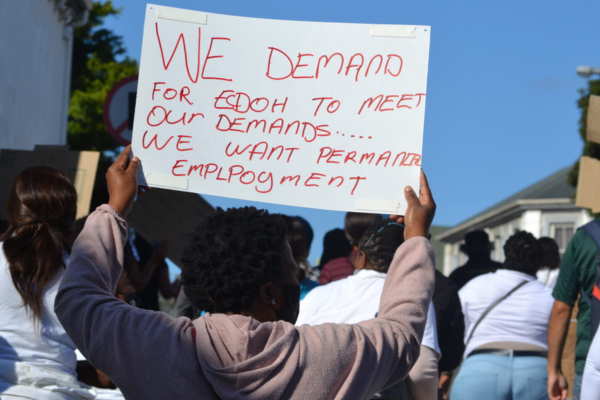

South Africa is drowning in unemployment, poverty and inequality. Millions are desperate for work and services are collapsing while a narrow elite captures the spoils of public budgets and municipal contracts.
The struggle against apartheid united the overwhelming majority across the racial and ethnic boundaries consciously constructed by the white minority regime as part of the strategy of divide-and-rule to prevent solidarity in a common struggle against racial oppression and class exploitation. Today the political climate in SA is seeing the return of racism, tribalism and xenophobia. The champions of these poisonous ideas have become increasingly emboldened. They draw their inspiration from the ANC’s capitalist policies.
Enough is Enough’s establishment, sparked by the dismissals of comrades Gayle Grootboom and Kupido Baron, is aimed at drawing a line under this assault on the gains of the struggle against apartheid, to demand equal opportunities for all, and an end to racial discrimination and injustice. However, the experience of the campaign has led Enough is Enough early on to conclude that the solution to this discrimination requires a struggle for jobs for all irrespective of race. This represents an important step forward in understanding that the effect, if not the conscious intention of these government policies is to pit working class communities of different races against each other for a diminishing pool of jobs. Enough is Enough is therefore campaigning for class solidarity across the racial, ethnic apartheid walls being reconstructed.
The government’s policies have provided the basis for forces attempting to rally the victims of unemployment and poverty by exploiting the sense of racial injustice felt by particular sections who face this discrimination directly in the form that it takes – that jobs and promotional opportunities for the Black majority take precedence over those of what are now referred to as “minorities”. Yet the reality is that, per head of population, it is the very Black working class majority who, suffer the consequences of the government’s neo-liberal capitalist polices the worst in terms of mass unemployment and poverty. They are at the bottom of the social pyramid of destitution followed by Coloureds. The same social pyramid of class divisions that took on a racial form under apartheid, continues today under bourgeois democracy. The black working class majority are not “previously disadvantaged”- they continue to be so.
Parties like the Patriotic Alliance, the Coloured People’s Congress and similar formations are playing the same role in relation to Coloureds as do ActionSA, Operation Dudula, and the PA which is playing a dual role – pitting South Africans against African foreign nationals and depicting Coloureds as marginalised for the benefit of Black Africans. They advance the careers of their leaders who aim to plant their noses into the government trough for self-enrichment. They provide a cover for and distraction from the government and the capitalist class’ culpability for the rampant poverty and mass unemployment suffered by working class people of all races.
Post-apartheid SA’s constitution is supposedly the founding document aimed at achieving a non-racial, non-sexist and democratic SA. Yet these comrades’ dismissals betray every aspect of these lofty aspirations. Comrade Kupido’s dismissal was sparked by his refusal to accept his denial from even being considered for promotion into a post he had been acting in and excelled, on the racist ground that he is Coloured. Comrade Gayle’s dismissal represents a contemptuous repudiation of the constitution’s commitment to the eradication of gender discrimination and the tyranny of undemocratic practices in the workplace marked by a callous inhumanity towards her physical and mental well-being.
Comrade Gayle and Kupido’s victimisation are not isolated incidents. Anecdotal evidence is plentiful of Coloureds who apply for jobs and filling in their application forms “Black”, only to be told “But You are not Black Black.” Yet the EAA defines “Black” as “Coloured, Indian an African.” There is therefore no basis for the preferential treatment of one over the other.
But this discrimination has also taken a tribal form. The EFF recently protested publicly that if you cannot speak Tshivenda, you cannot get a job in Limpopo in which the majority is predominantly Sepedi speaking. Helen Zille’s denunciation of people from the Eastern Cape coming to the Western Cape for jobs as “refugees” is thinly veiled tribalism. She is in fact inciting the Western Cape separatism which has spawned movements openly calling for Western Cape independence. Similar sentiments are sprouting in the KZN. These are all fruits of the same poisonous tree – capitalism whose preservation was central to and the main strategic objective of the negotiated settlement at Codesa. The elites of all the different racial groups are mobilising “their” constituencies in pursuit of their own class ambitions to get a piece of the capitalist pie at the expense of those constituencies.
The political and economic elites are showing the symptoms of recidivism – the tendency of a convicted criminal to re-offend. Their conduct has evolved into a systemic resuscitation of the very practices the struggle against apartheid was dedicated to eradicating.
What lies at the root of these developments?
The ANC came to power believing that it would be possible to eradicate the inequalities inherited from apartheid without dismantling capitalism which the aspirant black capitalist class it represents wants to be assimilated into. The main legislative instruments for what was called “transformation” were Black Economic Empowerment (BEE) and the Employment Equity Act (EEA) presented as aimed at expanding “ownership” and inclusivity at the top of the economy and employment and promotional opportunities in the workplace at the bottom. The driving force for BEE was the incubation a black capitalist class that would rise to the summits of the economy to occupy a position in proportion to the demographics of the country. EEA was the instrument to break down the barriers to employment and promotional opportunities for African, Coloured and Indian – those “previously disadvantaged” by apartheid job reservation and the deliberate obstruction to the acquisition of skills under an inferior education system. In this vision there would be both ownership and jobs for all. On the basis of capitalism, this was always utopian.
BEE has not only been a dismal failure. It has become discredited as a result of the fact that it has benefitted a connected few who have become fabulously wealthy. Ownership as the Competition Commission has reported, has become more concentrated. The top 10% owns 84% of the country’s wealth in income and assets. Although Blacks (Coloured, Indian and African) make up just under half of the top 10%, there is only one wholly black owned company in the top 100 of the Johannesburg Stock Exchange. As economist Duma Gqubule points out:
“Wits University professor William-Mervin Gumede recently said R1-trillion had been transferred to about 100 politically connected people. A quick sense check should make it obvious that this is not true. It means that the 100 individuals received an average of R10bn each, which is clearly nonsense.
I am the expert on this topic and have interviewed and met most of the founders and leaders of large BEE companies. After 31 years of democracy there is now a “super league” of about 30 companies (not individuals) that are worth more than R1bn. A handful are worth more than R10bn.”
There is no space to do justice to the latest fake news about BEE. Solidarity and the Free Market Foundation said JSE firms had achieved 30% black ownership and that R1-trillion to R2-trillion in equity had shifted since 1994. But black ownership on the JSE is not 30%.
There is a “voodoo system” of accounting for black ownership. There is no relationship between actual ownership — as reported by companies in their annual reports — and the figures that appear on their BEE certificates.
Pick n Pay has never done a BEE transaction, yet its 2025 verification certificate shows that is has black ownership of 22.2%. At the end of 2022 there was black ownership of R228bn within the top 50 companies on the JSE, which accounted for 93% of the exchange’s market capitalisation.
This was equivalent to 1.2% of the market capitalisation of the top 50 companies. After excluding the value of foreign assets of listed companies, black ownership was 5.8% of the value of SA assets. (emphasis added) (BL premium 22 July 2025)
In an attempt to resuscitate its credibility BEE, was reinvented as Broad Based Black Economic Empowerment “Triple BEE.” It’s aim was to achieve BEE’s original aim of “economic transformation” by expanding the criteria for businesses to achieve the different levels of empowerment classification. BBBEE was now broadened to specifically include women, workers, youth, people with disabilities, and those in rural areas. Its strategies, like promoting black ownership and management, skills development, equitable representation, and preferential procurement and thus portrayed as a complementary instrument to the EEA.
BEE had been thoroughly corrupted by big business through fronting that Gqubule describes as “blackwashing” and fraud that aspirant black capitalists have been only too willing to collude in.
EEA
The EEA amendments were introduced to restore its credibility after a similar failure to reduce let alone eradicate poverty and mass unemployment. The National Development Plan, chaired by Ramaphosa, stated in 2012 that for the extreme poverty (not poverty in totality) to be eliminated and unemployment reduced (not eradicated) by 2030, the economy would have to grow at the rate of 5.6% per annum for 10 years consecutively. This in turn would require an overall investment (public and private) rate of 30% of GDP by 2030, up from 17%.
What have been the results? Annual economic growth has averaged 1% over the lifetime of the NDP. According to the SA Federation of Trade Unions, since 1994, manufacturing’s share of GDP has declined from 22% to just over 11%. Capacity utilisation has dropped from 82% to around 65%. (Statement 09/05/2025). This means that there are millions of jobs that could be created if the other 35% were utilised.
As Duma Gqubule points out, since Ramaphosa became president:
“…there were eight out of 10 quarters of declining gross fixed capital formation (GFCF), a measure of investment before the lockdown at the end of March 2020. In February 2019 the government announced a R100bn infrastructure fund. Four years later it does not contain a cent. Despite four investment summits where pledges of R1.1-trillion were made, GFCF plunged to 13.1% of GDP in 2021 — the lowest since 1946 when the Reserve Bank started collecting statistics — from 16.4% in 2017.
From the fourth quarter of 2017 to the first quarter of 2020 the SA labour force increased by 1.8-million and the economy created 212,000 jobs. The number of unemployed people soared by 1.6-million to 10.8-million and the unemployment rate increased to 39.7% from 36.3%. The economy was collapsing before the pandemic. Since Ramaphosa became president the number of unemployed people has increased by 2.7-million to 11.9-million. The unemployment rate has increased to 43%. (emphasis added) (BL Premium 07/02/2025)
This is the background against which the abuse of the EEA amendments must be understood. For both BEE and EEA’s aims to be realised required increased investment and economic growth. But both the government and the capitalists are not investing. At Codesa, the capitalists promised to invest if corporate tax was to be reduced. The government complied and reduced it from 52% in 1993 to 27% today.
As the GFCF figures above show, they have not invested. Instead there has been capital flight of trillions over and above illicit capital flows of R400bn per annum according to Judge Dennis Davies who was appointed by SARS to investigate this theft. The top 10% of the 2 000 multinationals operating in SA are responsible for 90% of it. Capital flight stands GFCF includes public investment. The reduction in corporate tax has led to a chronic budget deficit. The government plugs this by borrowing R2.5bn on the financial markets every single day. They pay R1,1bn a day on the interest of this debt to avoid a default. Thus 20% of the annual budget is set aside to service the debt which is the first priority before spending on anything else.
A default would be highly damaging and precipitate massive capital flight and a collapse in the value of the Rand which is already one of the most volatile currencies in the world. This in turn would require raising interest rate that would increase the indebtedness of consumers 9m of whom are already 3 months in arrears with their bond, car, retail and personal debt repayments. It would also strangle economic activity as especially, but not only, small business would not be able to cope with repayments and therefore shut down and retrench. So the government’s “solution” is to cut spending on social services even more savagely. To make matters worse, the announcement that the inflation target will be reduced can only be achieved by increasing interest rates. This will create greater indebtedness, increased unemployment, even deeper poverty and necessitate further social spending cuts.
To make matters worse the capitalist class and their black apprentices have engaged in an orgy of looting, plunder and corruption as first the Zondo Commission revealed. The Madlanga Commission’s subsequent revelations of eye-watering corruption show this has become even more brazen.
That the EEA has become a flashpoint was thus inevitable. When mass unemployment and poverty increases, its aims are not only unrealisable; quotas are turned into the reincarnation of apartheid job reservation – a competition for a diminishing number of jobs and promotional opportunities that can only result in bitterness and animosity. EEA is weaponised to achieve multiple purposes: to conceal the reality of the overall failure of the government’s macro-economic policies, to turn the working class against each other by converting EEA into tools for division and to enrich a tiny elite. “Redress” in the form of BEE and the EEA has been an unmitigated failure both at the top and bottom of society.
The problem lies in SA’s crisis-ridden capitalist economy – the preservation of which was the strategic aim of the negotiate settlement at Codesa. At the best of times, capitalism is incapable of providing permanent jobs, decent wages and conditions for all. The ANC’s 1994 election slogan: “jobs for all” was always an impossible goal. The neo-liberal model of capitalism that the apartheid regime began in the 1980s, the Normative Economic Policy, was continued and rebranded as the Growth Employment and Redistribution (Gear) policy and imposed by the ANC leadership on both the party and the country, turned that promise into it opposite. Gear is a programme to privatise state owned enterprises, outsource public services, reduce corporate taxes and cut social spending.
The result has been an economy that has failed to keep pace with a growing population and the increased need for social services. This has led to job losses, stagnant wages and a deterioration in social services. Superimposed on the “jobs for all” promise that could never be fulfilled, has been the ANC’s commitment to its historical mission – the creation of the “prosperous non-European bourgeoisie” as Mandela pointed out in his 1956 article, “In our Lifetime” – a rich black capitalist class.
Today the World Bank has classified SA as the most unequal society on the planet. The top 10% owns 84% of the wealth in income and assets. The bottom 50% have negative wealth because of debt. Although amongst the wealthy, Coloureds, Indians and Africans make up just under half of the top 10%, the widest disparities in the distribution of wealth are no longer between white and black but within the black African population itself, followed closely behind by inequalities amongst Coloureds.
The fact that the GNU has now revised its economic growth ambitions downwards to 3% – a target that many capitalist economists themselves regard as unattainable – is a confession that poverty and mass unemployment is here to stay.
Numerical targets already applied without transparency or accountability can only become instruments of division – attempting to empty the sea of mass unemployment and poverty one teaspoon at a time while the rivers of capitalism continue to pour out into the sea. The protection of workers’ rights, stoking divisions amongst them, managerial and political practices that substitute patronage for merit – are all inevitable.
Dignified employment for all requires the demands for fair employment practices for all combined with a broader campaign for the restoration of municipal service delivery capacity, through ending privatisation and outsourcing and the abolition of BEE and the EEA. The abuse of these allegedly transformation instruments ultimately stem from budget cuts that lie at the heart of national government’s macro-economic policies. The demands that follow are the practical compass for a class‑based, inclusive politics that rejects both scapegoating and managerial manipulation.
The DA of course opposes BEE and the EEA. But they do so from the standpoint of capitalism. For them these measures interfere with the “free market” whose “invisible hand” ensures greater economic efficiency, creates more jobs and ensures economic growth. The same DA, however, opposes a minimum wage, proposes that the unemployed be given vouchers, opposes strikes for higher wages and better conditions. By the logic of their argument under apartheid when black workers in particular did not have the right to form unions and strike there should have been full employment and prosperity for all
BEE quotas themselves limit share ownership to the “previously disadvantaged” to 30%. That means the top 10% should keep 70% whilst 30% is left for the bottom 90% even without considering the status, quality and legitimacy of the shares owned by the 30%. This is self-evidently not a formula for equality. Objective reality exposes the idea that there can be both equal share ownership and equality of employment under capitalism as a fantasy. Capitalists have historically introduced share ownership schemes to discourage workers from demanding higher wages, to discourage strikes and to weaken unions by giving them a stake in the company and the capitalist economy.
Equality of ownership requires the abolition of private ownership. Since private ownership is the cornerstone of capitalism, it requires the abolition of capitalism. Mining industry bosses have screamed blue murder because the “previously disadvantaged” shareholders sell their shares as soon as market prices go up to make a profit. This brings their BEE score cards below 30%. So they argue that the rule that should apply to the mining industry is ”once empowered, always empowered”. But that goes against free market” do as you please” principles. The DA, moreover, was the main driver along with business behind the amendments to the LRA that amount to the most serious assault on worker rights.
We argue for the abolition of BEE and the EEA from the standpoint of the working class. They entrench inequalities whilst pretending to do the opposite, do not prevent the normal workings of the capitalist system that requires driving down wages to increase profits, and leads to greater concentration and monopolies from competition itself. These contradictions are inherent to capitalism. Equality of ownership can only be achieved on the basis of collective ownership of the economy by society as a whole – i.e socialism. Production and distribution will be organised democratically for the satisfaction of social need not private profit. The surplus produced by the labour of all be owned by society as a whole and inequalities abolished. Our struggle is based on achieving that objective.
- BEE and EEA must be abolished. They have a proven track record of failure and are used to deceive and divide the working class by promoting the fiction that there are enough jobs for all but that all that is needed is to be allocated on a racially proportionally equitable basis. The only “equity” that BEE and EEA have achieved is in respect of unemployment and poverty. The distribution of destitution reflects the demographics of the country – Black Africans at the bottom, followed by Coloured Indians and Whites
- However, in the meantime all appointment must be transparent and accountable. All public sector and municipal appointments must have published shortlists, clear selection criteria and independent oversight. Contested appointments should be reviewable by independent panels with trade union oversight. Transparency removes the cloak that allows EEA compliance to become a cover for patronage.
- Fill vacancies as a binding obligation. Municipal services collapse has resulted in hundreds or thousands of posts remaining vacant. Filling these posts reduces destructive overtime abuse, cuts dependence on profit-driven contractors who themselves undermine worker rights under the Basic Conditions of Employment Act and the LRA. It would restore the capacity of local government to deliver essential services that underpin local economies under democratic oversight of communities.
- End exploitative cheap labour schemes like EPWP. For permanent, collectively‑bargained positions with living wages and full labour protection.
- Protect and restore collective bargaining. Exemptions from collective agreements under the pretext of “affordability” must be rejected. Collective bargaining is not a ceremonial ritual; it is a fundamental mechanism to secure decent wages and conditions and dignity for working people.
- For independent investigations with trade union representation into discriminatory labour practices. Independent committees must be empowered to examine dismissals, appointments, overtime practices and procurement processes for evidence of collusion or discrimination. Findings must be public and enforceable.
- Affirmative action measures must be based on special programmes for the provision of skills, recognition of prior learning to eliminate the advantages and social capital whites enjoyed under apartheid. This will ensure that those advantages are eliminated and enable all who compete for positions do so on an equal footing.
- The reintroduction of apprenticeships, combined with the abolition of outsourcing and privatisation will increase the capacity of the state along with expanding the number of jobs and permanent employment.
- Reinvigorate equality institutions. Equality courts, the SA Human Rights Commission and other mechanisms must be properly resourced, given powers of compliance enforcement to resolve discrimination.
We must build a campaign that unites workers across racial lines while holding managers and political elites to account. Campaign messaging must centre jobs, dignity and accountability. The movement must expose practices of collusion and patronage.
We must avoid the twin dangers of insensitivity to a sense of racial discrimination and the conversion of legitimate grievances into campaigns for neoliberal racialised “solutions” — lower wages, weaker protections and vouchers for the unemployed. We must do this by patiently addressing any misperceptions using facts, figures and argument that show that irrespective of race, the working class as a whole have much more in common with each other across racial boundaries than they have with the elites seeking to politically exploit them within racial laagers. Both paths lead to reactionary mobilisation on a racial basis lead away from collective emancipation.
Our strategy must be unapologetically class‑based. It must insist that employers, political parties and managers stop using “transformation” to keep things the same – a cover for casualisation and patronage. We must demand the state uses procurement, budgets and hiring to create secure, well‑paid employment as the only way to redress historical inequalities.
Enough is Enough requires militant demands for the filling of existing vacancies and the creation of new positions commensurate with the requirements of decent service delivery for all. No appointments without trade union oversight to ensure transparency, permanent decent work, and restored bargaining rights. It requires a movement that refuses to be divided along the lines that elites and reactionary actors use to protect their privilege.
Jobs for all is not just a slogan; it is a political program. It places before the working class the wider task of the socialist transformation of society as a whole. This is only possible on the basis of working class unity in struggle in communities, in the education sector, in all workplaces united within each other in a United Socialist Civic Federation, a Marxist Youth and Student Movement, a Socialist Womens Movement, a Socialist Trade Union Confederation united across all these separate theatres of struggle under a mass workers party on a socialist programme.