
The Garbage “Strong-arm”
Originally published in Inqaba ya Basebenzi No. 1 (January 1981).
by P. Qubulashe[1]
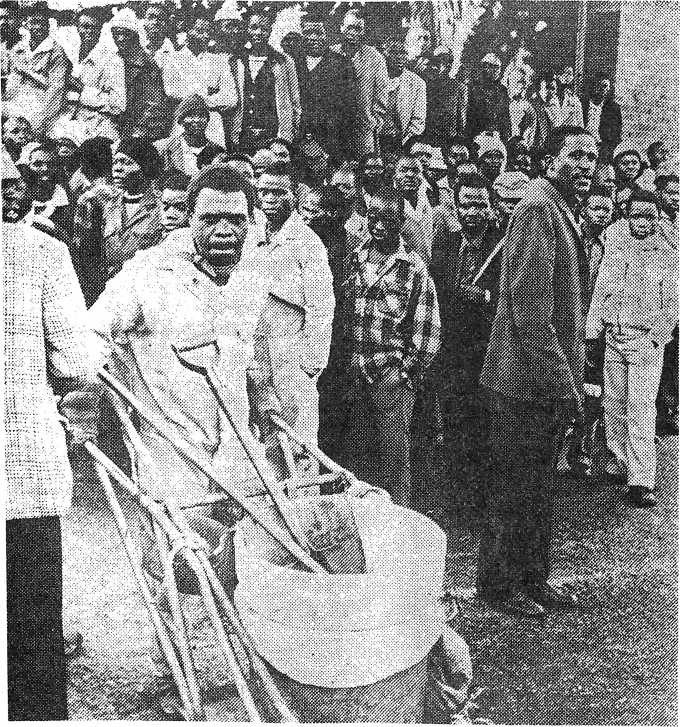
In eight days, a strike of ten thousand black workers in the pay of the Johannesburg City Council was crushed. In terms of both the duration of the strike and the staggering number of workers involved this sounds incredible. The fact remains that this section of the workforce has suffered a heavy blow at the hands of the capitalist robbers.
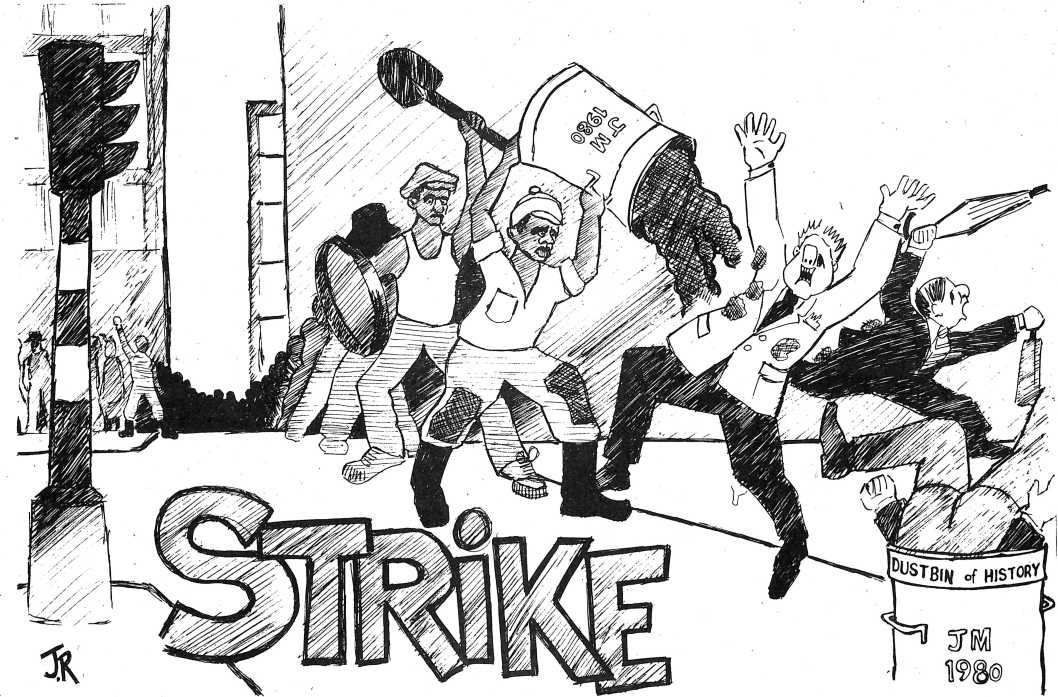
The City Council authorities used the police in forcing the workers, at gun point, to work. When this failed, these capitalist bandits continued to use the police. At gun point, the police split the workers and subsequently succeeded in bundling – they have coined a word ‘busing’ to hide their savage acts against the workers – 1,200 workers to the Bantustan poverty graveyard.
These workers were not allowed to collect their belongings. The compound officials, the sergeants-at-arms who enforce order in the labour camps called compounds, described the belongings of the workers as “rubbish”. The workers were starved for two days until 3 a.m. Friday when they were given a half-loaf or a loaf of bread. The 1,200 workers are to be replaced with a contingent – dragooned by poverty – from the Bantustans.
Besides the very criminal act on the part of the government in using Council officials and police armed with shotguns, TI rifles, and semi-automatic pistols against defenceless workers, the same government orders the arrest of the union leader, Joseph Mavi, as a political offender. He faces charges under either the Riotous Assemblies Act or the General Law Amendment Act, both of which contain sections referring to breaches of contract by employees in public utility services and the disrupting or threatening of these services.
Fanie Botha, Minister of Manpower Utilisation, and his civil servant bureaucrats give funny explanations in trying to justify the police action against workers.
Fanie Botha complained that “the Government’s conciliation machinery was available to the strikers, but they had chosen not to use it”. But if the strikers ignored it, as they did, was Fanie troubled to ask the question: why do the workers refuse to use his machinery?
Slapped
A little bureaucrat, a so-called senior civil servant, adds his funny arguments to Fanie’s. He convulses in an epileptic fashion:
For years these people [which people?] bombarded us with demands that we allow black trade unions to register and join the system. Now, when we agree to that, they slap us in the face.
Unfortunately, the workers did slap the face of this bunch of bureaucrats! For the trap was set for workers in the form of what Fanie Botha calls “Government conciliation machinery”. In other words, the so-called legal permission of the capitalists for the workers to form and register their trade unions.
But this trap did not frighten the workers. Instead the capitalists themselves got frightened as the workers beat them at their own trick.
For what is this so-called legal permission? Here this learned civil servant along with his master betray their total dishonesty. The government refused to register the Black Municipal Workers Union under its “conciliation machinery”. The City Council refused to negotiate with this union on the grounds that it is not registered. And further, the Council sponsored a reactionary union, the Union of Johannesburg Municipal Workers, which does not represent the workers but represents the Council against the workers.
Of course, no worker expects honesty from this crowd of bandits. The workers slapped the face of the bureaucrats – by striking. The liberals and their sycophants wildly moan over “the disgraceful tactics” and the “strong-arm tactics” of the Council in breaking the strike. Now, to be morally indignant, like these liberal gentry and some political cranks, over the criminal acts of the capitalist government against the workers is either not to understand the whole class issue or to cloud deliberately that very class question.
It is like some learned people who claim to be fighting for the interests of the workers (not that the workers need anybody to fight for them), but insist that the workers should only involve themselves in trade union activity but not in class political activity.
For the government has always been making the point clear that this is a class conflict. The capitalist laws weigh down heavily on the workers. Hence a breach of contract by workers is a criminal offence. The stoppage of work by workers in support of their wage demands is by the same laws stipulated as an act of sabotage. The municipal workers were operating an “essential service”, where strikes are always illegal and disputes must be submitted to “compulsory arbitration by a third party” – in other words the government and the whole crowd of capitalists hiding behind it.
‘Public Order’
In fact the same wailing liberals did not object to the presence of the police. The Rand Daily Mail of 1 August stated “Policemen were present, which they must be when public order might be endangered”. In addition to this, a policeman stated, for the benefit of his masters, that “our interests are simply to ensure peace and calm, and to stay out of domestic grievances”.
But there was no evidence that “public order might be endangered” by the workers. And when and how did the issue cease to be “domestic grievances”?
All this crowd – the liberals and the government alike – have chosen to ignore the fact that the City Council authorities, when refusing to meet the demands of the workers, were therefore responsible for “public order” being “endangered”; and that for that very same reason the “domestic grievances” had ceased to be “domestic”; and that Fanie’s “government conciliation machinery”, consequent on the refusal to register the workers’ union, rendered that machinery useless for the workers.
Conviction
On their grounds, the liberals should have argued for the conviction of the City Council under the Riotous Assemblies Act and the General Law Amendment Act. But they didn’t, which makes it outrightly clear, despite the apparent bickering within this variegated crowd, that they are unanimous on the question of police intervention on the side of the capitalists, for they also consider strike action by workers as constituting a public disturbance. Hence the same issue of the Rand Daily Mail notices no absurdity in the statement that “At least up to yesterday morning the police approach to the strike was proper and correct”.
Marx long ago explained this question of class conflict in terms which up to date still remain true: “a class struggle is a political struggle”. And the important point is that class conflict can never be resolved by arguments but by force. So the “proper and correct approach” for the capitalists is when the police are there – strategically positioned to assault the workers whenever the authorities, intoxicated with the possibility of victory, find reason to massacre defenceless workers.
In fact the “strong-arm tactics” the liberals secretly appreciate and endorse. But there is a nightmare, inherent in this action, that haunts them.
This fear of the liberals is expressed in the editorial of the Rand Daily Mail in this manner: “That is no way to end a labour conflict; it does not resolve grievances but at best can only force them out of sight, perhaps to surface later in more virulent form”. Since these workmen limited their grievances to wage questions, say these able agents of capitalism, the liberals, the City Council should have met the wage demands.
For what has offended the liberals in relation to the brutal handling of workers is the fact that such puffed-up arrogance and savage recklessness of the City Council through the actions of the police betrays the stupidity of the capitalist authorities. This in turn, and this being most feared by liberals, enables the workers to explode, in their class workers’ consciousness, the myth that the police force or the whole capitalist state machinery is neutral on the question of class conflict between the capitalists and workers.
We may permit ourselves to ask Mr Editor of the RDM a question. Since, Mr Editor, you mention the consequences “at best”, what will it be “at worst”? Is it not when the capitalist state is itself the issue at stake?
The liberals and their kind explain the defeat of the strike by the “strong-arm tactics” of the police and the council. But this is no explanation. The police have always intervened, in every dispute between the capitalists and the workers, on the side of the capitalists. That has never played a decisive role in the defeat of the workers. At most it has been a contributory factor.
One learned commentator of the SABC noted that in Johannesburg the employer and production did not suffer from the strike. But he failed to explain why. Perhaps, we may assume, he feared to reveal the truth. We, on the contrary, are not averse to truth.
This commentator should have known that the fifty electricians who started it all, and who have since been fired, constituted a very significant number to affect production and employers. But white electricians came to man the electric installations. These white workers work with the assistance of what they call “piccanin” electricians who do most of the work at low wages. And these white worker electricians have not yet found reason to down tools.
That is not because they are “responsible”, but because their high wages and all the socio-economic privileges accorded to them as a capitalist political measure to swindle them, have blurred their working class consciousness. Hence they cannot even support their black counterparts. This then, is one aspect of the explanation of why the strike failed.
The second aspect of the defeat of the strike is that the capitalists designed the Bantustan in such a manner that there should always be a huge army of starving unemployed workers in the Bantustans. These starved unemployed workers are, at a moment’s notice, brought in to replace dismissed fellow workers.
This state of affairs is confirmed in no uncertain terms by the reactionary Mr N.E. Mulaudzi, so-called deputy-director of the Homelands Information Service, who is reported to have said that “the Council had approached the Venda government for help in recruiting fresh labour”, and that “magistrates in four districts would report by next Wednesday on whether labour would be available”. Thus the question of recruiting unskilled labour, the majority of the municipal workers, played well right into the hands of the City Council scoundrels, thereby enabling these capitalist villains to smash the strike.
United
From these two points, which make up the cause of the defeat of the strike, a disturbing fact emerges – that the workers are not well organised.
If the workers were properly organised, the Bantustan bubble would have burst asunder at the slightest touch. The question of unskilled labour could not have been decisive in the defeat of the strike if the workers of other industrial sectors had come up in support of the Municipal workers.
Therefore the question of national working class unity is fundamentally important and necessary for the struggle of the working class at whatever level it is carried on. That unity of the working class would have forced the police, pursuing their “interests” of truncheoning, booting and butting defenceless workers, to stop this pursuit altogether.
The same commentator on the SABC announced that the horrors of Europe and America, where society is held to ransom by “irresponsible people”, (he means workers) had arrived in Johannesburg.
We may, in passing, give a friendly piece of advice to this learned commentator, that it is important to know history in order to understand the social processes. This same section of the black working class – the municipal workers – struck in 1918 in support of wage demands. The defeat of 1980, like that of 1918, is not a new phenomenon in South African labour history.
Instead 1980 reveals a continuous process in the history of South African capitalism. A process which is subject to laws of change both in quantity and in quality. It is this character of changeability that gives more and more strength to the combativity of the working class. In this process of developmental change the workmen get more and more well-organised in big fighting contingents. This is precisely what terrifies the liberals, the able agents of capitalism.
But we also agree with the learned commentator, but not from his expressed point of view of horror and dismay, that the deadly intensified class conflict in Europe has now become a way of life in capitalist South Africa.
For us that is a point which shows the decay of capitalism the world over, and the maturing development of the working class not only in Europe, but all over the world.
Decayed capitalism is a social garbage. That the ten thousand strong workmen have been defeated by this garbage is like the act of a man who deviates from the path that leads him to his decided goal. He had to deviate because on that path there is a heap of garbage that emits choking stench and he happens not to have a mask to protect himself. And, indeed, a garbage stench is a killer, given certain conditions.
In that respect, the ten thousand strong workforce has merely retreated – in order to regroup at a higher plane, with more battle equipment.
© Transcribed from the original by the Marxist Workers Party (2021).
[1] The writer, born in the Transkei, first worked as a ‘paniwela’ on a Natal sugar plantation at the age of 13. Returning to school, he was expelled for political activities; participated in the Pondoland uprising; went as a migrant worker to the gold mines; and later entered industry as a machine operator. He has many years’ experience in underground political work.
