
Originally published in Inqaba ya Basebenzi No. 18/19 (February 1986).
BTR, the British-based multinational, sacked 1,000 black workers at Sarmcol in Howick in May 1985. Their struggle for reinstatement and recognition of their union, the Metal and Allied Workers’ Union (Mawu) continues.
Campaigning work in the British labour movement is beginning to attract support from shop stewards and workers at BTR plants there, highlighting the need for more international direct links.
RAY HOWLEY, union convenor at BTR’s Greengate Polymer Coatings plant in Manchester, General Municipal Boilermakers & Allied Trades Union branch chairman and member of GMBATU North West Regional Council, spoke to DANIEL HUGO about conditions at BTR in Britain:
BTR is a group of companies under one banner which are supposed to be autonomous. Silvertown House (BTR headquarters) is only supposed to provide the companies with back-up.
In fact many people believe that Silvertown House actually issues rules to the companies which are kept under the desk. We as a union try to negotiate locally with the companies, but you can’t do that if the decisions aren’t made locally. And BTR refuses to negotiate nationally.
Take wages. When we negotiate locally management always insists that their offer is one-off in the plant. But it seems that the same kind of ceiling is operating throughout the country. Are we really negotiating with the people that we should be negotiating with?
BTR’s tactics were shown up graphically with the takeover of Dunlop last year. At Dunlop there was a good national negotiating body under GMBATU. BTR’s first step was to do away with it.
The union wrote BTR a letter, asking them to negotiate nationally. They refused. They said the company had been broken up into its ‘component parts’. Then they did away with the redundancy payment scheme in each ‘component part’. Letters were sent out in each company in September, saying that the scheme would be finishing.
Management told the union: “We made the decision ourselves. It wasn’t a national thing.” If it wasn’t a national thing, why did it happen throughout Dunlop at the same time?
In GMBATU we wanted to take them on over this. The problem is that there were six unions involved. We took a strike ballot and got an overall majority in favour of strike action. But due to policies followed by different unions with regard to majorities for strike action, no strike was called. And due to the indecision of the leadership, no action has been taken up to this time.
So BTR’s strategy seems to be working well. It takes groups over, then splits them up. It agrees to have local negotiations only. That is the major problem we face.
Have the unions found a way of fighting back?
No. The unions are in a bad position at the moment. Many of the leaders would seem to be scared to death. They’ve seen the NGA (print union) and the miners and other groups beaten – in fact they stood by and let it happen. This has put the employers in a stronger position.
On top of it, Thatcher has been giving support to the employers with her anti-trade union laws. We’ll have to do something. If we don’t, we’ll be lost.
What do you think should be done?
A lot of people tell us what we should be doing, and sometimes they’ve got good ideas. Take the question of South Africa, and refusing to do work for the companies down there. I found out that our company was doing work for Sarmcol. When I approached the membership about it, there was indifference at first.
The reason is that we haven’t got a solid policy on South Africa in the union. The leadership say a lot of high-minded things about South Africa, but there is no clear policy on what we should be doing.
Some trade union leaders would have us believe that any action in support of our brothers and sisters in South Africa would be breaking the law. So nothing is done! It seems to be TUC and Labour Party policy to stay within the law at all costs. But unless we are willing to stand up, we’ll keep on being the losers.
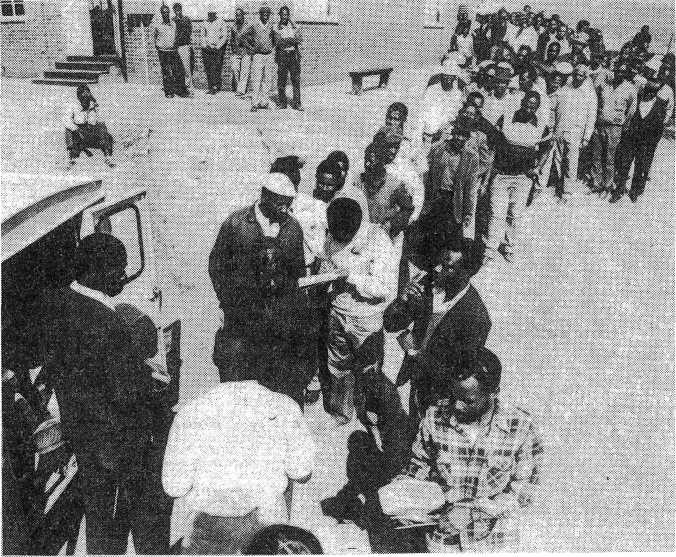
What do you think about the struggle of the workers at Sarmcol in South Africa?
I think the situation down there is symptomatic of what a company like BTR does. It’s exactly the same thing as here, except that they don’t yet have the same repressive laws to use against us in this country.
I’m hoping that we’ll be able to go from financial and moral support for the workers in South Africa to action on the shop floor.
The first problem would be to set up a national negotiating body which BTR would actually talk to. Some people have been working hard to build it up. This would make it possible to co-ordinate action. Once we do it, we’ll be able to move much more effectively.
In BTR the thoughts of a lot of people go out to Sarmcol. We have a hell of a lot of admiration for them, it’s a hell of a struggle they are waging. In fact, we should be learning from them. They are showing us what trade unionism is all about.
A lot of trade unionists are despairing here in Britain, because we seem to be getting beaten all the time. We can say that we’re having it hard at the moment, but in South Africa it’s a lot bloody harder.
What really fills us with admiration is that they’ve got the regime on the run – ordinary shop-floor workers. Maybe we can teach them something about organisation and structures. But they can certainly teach us how grass-roots trade unionism really works.

Do you think shop-floor workers at BTR in Britain can put real pressure on management over the Sarmcol issue?
The biggest problem is that people tend to slog away at their jobs, and don’t want to know about things which they think don’t concern them. But when they are faced clearly with an issue, they rise to the occasion. Take Ethiopia – once people saw things on the television, they put their hands into their pockets.
It’s the same with Sarmcol. Our brothers and sisters in South Africa will have to talk to us. We must be able to convey the reality of what is happening to our people on the shop floor. We must be able to let them know what’s going on. Management and the establishment won’t do it because it’s not in their interests. We must find our own ways of doing it.
© Transcribed from the original by the Marxist Workers Party (2021).
